Continuing care that lasts
Outpatient Rehab in Berlin, NJ
Standard outpatient treatment is one or two sessions a week. That is the whole schedule, and the small size of it is the point: this is the level where recovery stops being the main thing on your calendar and becomes something you maintain around the rest of your life.
It is also the level people underestimate in both directions. Some arrive expecting it to do the work of a day program and are disappointed. Others finish an intensive program, feel steady, and decide they are done. The weeks right after a structured program ends carry real risk, and they are the weeks people plan for least.
What an outpatient rehab program is
Levels of care are defined by hours, not by how serious a person’s addiction is. Under the fourth edition of The ASAM Criteria, standard outpatient is Level 1.5: fewer than nine hours of clinical services a week for adults. Intensive outpatient sits above it, and partial care above that.
In practice, ours is one or two appointments a week: individual therapy, a group, or both, scheduled during business hours at our office on Route 73 in Berlin. There is no evening track, so the schedule is worth working out before you commit to it.
The change from the higher levels is not only fewer hours. In a day program, the program supplies the structure. At this level you supply it, and the sessions are where the structure gets checked. What did the week throw at you, what did you do with it, what needs adjusting. That is a different kind of work, and it is the kind that has to hold for years rather than weeks.
Who outpatient treatment is right for
Two groups of people belong at this level, and they arrive from opposite directions.
People stepping down. You have finished partial care or intensive outpatient, the crisis has passed, and you have a plan that is working. Continuing care keeps a clinician’s eyes on that plan while your life fills back in around it.
People starting here. Use is recent or moderate, you are not physically dependent, you have somewhere stable to sleep and people who know what is going on. Weekly therapy with a clinician who treats substance use disorders is a real intervention, and starting at a lighter level is not a lesser form of trying.
Outpatient is the wrong level, at least to begin with, when any of the following is true.
- Stopping would mean withdrawal from alcohol or benzodiazepines, which can be medically dangerous and needs a medical setting first.
- Use is daily and the week is organized around it. An hour on Thursday cannot compete with that.
- You have relapsed repeatedly while attending weekly sessions. The level of care is the thing to change, not your effort.
- A psychiatric condition is unstable enough that the substance use is not the most urgent problem in the room.
We do not offer detox, residential treatment, or any overnight care. When the assessment shows you need one of those, we say so and help arrange it, and many people come to us for outpatient care afterward. Enrolling someone in a level of care that cannot meet their need keeps a schedule full and helps nobody.
How our program works
What happens in outpatient rehab at South Jersey Recovery Program
Your schedule is built from the treatment plan, not from a standard package. Most weeks draw on four things.
-
Individual therapy
A session with your own therapist, working on whatever the week actually contained. Approaches include CBT for the thinking that precedes a decision, DBT skills for emotion that arrives faster than reasoning, and motivational interviewing when part of you is still arguing for use. Trauma-focused work is done individually.
-
Group
A weekly group run by a licensed clinician. At this level group does something specific: it is often the only place in the week where the subject comes up at all, with people who will notice if you go quiet.
-
Medication management
If you are taking naltrexone, buprenorphine, acamprosate, or disulfiram, the prescribing continues here and is coordinated with your outside providers and your pharmacy. Stopping treatment and stopping medication are two separate decisions.
-
Family sessions
Family therapy puts the people you live with in the room, which is where the plan for a hard evening gets agreed rather than assumed.
Running underneath all of it is the relapse prevention plan, revised as your life changes. The plan you wrote in a day program described a week you are no longer living. New job, new hours, a wedding, a funeral, a court date: each one changes the map, and outpatient sessions are where the map gets redrawn.
The weeks after an intensive program end are the risky ones
This is the part worth knowing before you decide you are finished.
Tolerance to opioids falls within days of stopping, so a dose that was ordinary a month ago can be fatal now. Most overdose deaths in New Jersey involve fentanyl or one of its analogs, according to the state Department of Health, which leaves very little margin for a miscalculation. The same logic applies to alcohol and benzodiazepines, and mixing either with an opioid is a common way a single return to use becomes an overdose.
If you have an opioid history, keep naloxone in the house and make sure someone who lives with you knows where it is and what to do: call 911 first, give one dose, and if there is no response within two to three minutes give another in the other nostril and keep going until help arrives. Stay with the person. Naloxone reverses opioids only, and New Jersey’s supply increasingly contains xylazine and medetomidine, which it does not reverse, so give it anyway and keep waiting for the ambulance even if the person stays sleepy. New Jersey pharmacies dispense naloxone without a prescription, and anyone 14 or older can get it free and anonymously at a participating pharmacy through the state’s Naloxone365 program. For a mental health crisis that is not an emergency, call or text 988.
Nothing about that is an argument for panic. It is an argument for staying connected to a clinician while the structure comes off, which is exactly what this level of care is.
How outpatient rehab fits with our other programs in South Jersey
The three levels are one program, not three products.
- Partial care is Monday through Friday, 9:30 a.m. to 3:30 p.m.
- Intensive outpatient is 9:30 a.m. to noon, five days a week to start and three as you step down.
- Outpatient is one or two sessions a week.
People move down as they stabilize and back up when something goes wrong, and moving back up is not a failure. It is the system working the way it was designed to. Tell us early. A return to a heavier schedule for a few weeks is a smaller thing than the alternative.
What we treat at this level is the same list as the rest of the program: alcohol, opioids, stimulants, prescription medication, cannabis, and the co-occurring psychiatric conditions that so often sit underneath. Our page on substance use disorders covers how the diagnosis is made.
Treating close to home is an advantage here more than at any other level, because outpatient care depends on people actually showing up week after week for a long time. Our post on the benefits of local addiction treatment in South Jersey goes into what proximity changes, and how to find the best addiction treatment covers what to ask any program before you enroll.
Paying for outpatient treatment
Outpatient care involves fewer clinical hours than partial care or intensive outpatient, and the bill generally reflects that, but what you actually pay depends on your plan’s deductible, copay, and network status rather than on the level of care alone. We verify benefits before you start and tell you what we find, including when the answer is unwelcome. A benefits check is an estimate of what your plan says it will do; it is not a guarantee of payment, and the final decision belongs to your plan. Use the insurance verification form or ask on the phone.
How long outpatient care should last
Longer than most people plan for. The National Institute on Drug Abuse holds that staying in treatment for an adequate period is critical, and that for residential or outpatient treatment, participation of less than 90 days is generally of limited effectiveness. NIDA does not say how to add up a stay that moves through three levels; we count the whole episode, which means a month of partial care plus a month of intensive outpatient puts you near the start of that range rather than at the end of it.
Addiction behaves like other chronic conditions in this respect. Nobody treats hypertension for six weeks and calls it finished. The lighter levels exist so that treatment can continue at a weight a person can actually carry.
Get started
Starting outpatient treatment in Berlin, NJ
It begins with an assessment: your history, what you are using, what else is going on medically and psychiatrically, and what your week looks like. That conversation decides the level of care, and it is also where we tell you if a different level would serve you better.
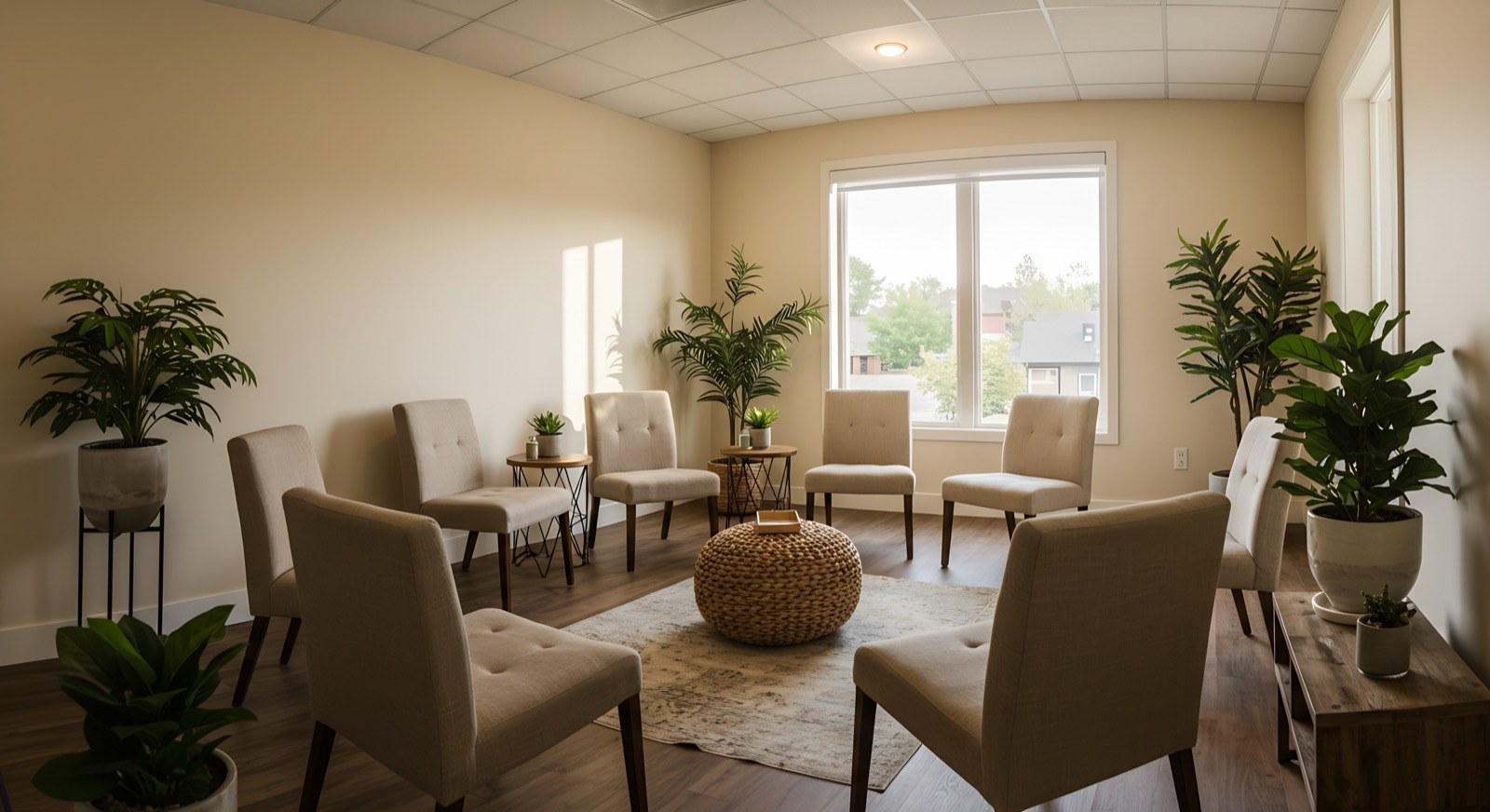
South Jersey Recovery Program is licensed by the New Jersey Department of Health as an Outpatient Substance Use Disorder Treatment Center, license #2001009. Our office is at 1044 NJ-73, Suite A, in Berlin, and you can see the space first. The admissions page explains what happens between the call and the first session.
Call (856) 788-6914 or contact us online. The consultation is confidential, and we can verify your insurance on the same call.
Sources
- American Society of Addiction Medicine. The ASAM Criteria: Treatment Criteria for Addictive, Substance-Related, and Co-Occurring Conditions, fourth edition, 2023. Level 1.5 (Outpatient), Level 2.1 (Intensive Outpatient), and Level 2.5 (High-Intensity Outpatient, licensed in New Jersey as partial care).
- National Institute on Drug Abuse. Principles of Drug Addiction Treatment: A Research-Based Guide, third edition, revised January 2018. nida.nih.gov/sites/default/files/podat-3rdEd-508.pdf
- Substance Abuse and Mental Health Services Administration. Opioid Overdose Prevention Toolkit.
- New Jersey Department of Human Services. Naloxone365 and overdose response guidance. nj.gov/humanservices/stopoverdoses/
- New Jersey Department of Health. New Jersey Marks Progress in Reducing Overdose Deaths While Honoring Lives Lost. August 29, 2025. nj.gov/health/news/2025/approved/20250829a.shtml
- U.S. Food and Drug Administration. Approved medications for opioid use disorder and alcohol use disorder; disulfiram prescribing information via DailyMed, label updated October 7, 2025.
Is this the right level of care?
An admissions coordinator can walk you through the options in a few minutes. The call is confidential.
From the blog
Related reading
Addiction Treatment
Benefits of Local Addiction Treatment in South Jersey, and When to Go Farther
When treatment close to home in South Jersey helps, when leaving is the better call, what research says about distance and follow-up, and how to vet a program.

Addiction Treatment
How to Find the Best Addiction Treatment Program
How to choose an addiction treatment program: match the level of care, verify the license and network status, and ask the questions brochures avoid.

Addiction Treatment
Does Medication-Assisted Treatment Work?
MAT combines FDA-approved medication with counseling to reduce cravings and relapse. Here is the evidence on how well it works and who it suits.
Areas we serve
Coming from a nearby town?
We have one office, in Berlin. These town guides cover the drive and what to know first.
Reviews
What clients and families say
5.0 out of 5 on Google, from 10 reviews
Read our reviews on GoogleReviews are written on Google by individual clients and family members. Results vary, and no review is a guarantee of any particular outcome.
Insurance
We work with many major insurance plans
What your plan covers depends on your policy and on whether we are in network with it, and we check both before you start. These are some of the plans our clients use. A logo here does not mean we are in network with every product a carrier sells. Whether or not you see your plan, request a verification and we will confirm your benefits and your network status before you start.









Recovery is waiting for you
Talk with our admissions team. Calls are confidential, and we will check your insurance benefits and call you back with what we find.