Highest level of outpatient care
Partial Care Program in Berlin, NJ
Partial care is the most treatment we provide in a week, and you still sleep at home. Programming runs Monday through Friday, 9:30 a.m. to 3:30 p.m., at our office on Route 73 in Berlin. Clinical staff are on site 8:30 a.m. to 4:30 p.m.
You will see the same level of care called a partial hospitalization program, or PHP. New Jersey licenses it as partial care, and that is the term that will appear on your paperwork. The names describe one thing: a full clinical day, five days a week, with no overnight stay.
The name is not the decision. The decision is whether the hours you spend away from us, meaning evenings, nights, and weekends, are hours you can get through. Partial care assumes they are. When they are not, the honest answer is residential treatment, and we would rather say that at the assessment than find it out in week two.
What a partial care program (PHP) is
Treatment is organized in levels, and the levels are defined by hours and supervision rather than by how serious the problem is. In the fourth edition of The ASAM Criteria, the level New Jersey licenses as partial care is Level 2.5, renamed High-Intensity Outpatient and still widely called partial hospitalization: 20 or more hours of clinical programming a week for adults, delivered during the day, with the client living at home. Residential treatment sits above it and adds a staffed overnight setting. Intensive outpatient is Level 2.1, nine to 19 hours a week, and standard outpatient is Level 1.5, fewer than nine.
The word “hospitalization” is a leftover from hospital day programs. There is no bed here, no overnight staff, and nobody watching over you once the day ends at 3:30. What there is, is a clinical day.
The reason a full day works when a weekly appointment does not has nothing to do with willpower. Daily use builds a routine: the same hours, the same drive, the same people, the same relief at the end of it. A single therapy hour asks you to change that routine using the twenty-three hours you already have. Partial care replaces the routine outright for the first stretch, which does three things a weekly session cannot. Skills get practiced the day you learn them. Trouble gets caught the morning after it starts instead of the following Tuesday. And the people managing your medication, your therapy, and your paperwork are in the same building, talking to each other about you.
Who partial care is the right level for
Most people arrive at this level from one of four directions.
You finished detox or a residential program somewhere else, and going straight to an hour a week would leave the rest of the day open. Stepping down through partial care is a common path, and clients come to us this way.
You tried a lower level and it did not hold. A relapse during intensive outpatient or weekly therapy is information about the level of care, not a verdict on you.
Use is daily or close to it, and the week has organized itself around it. Missed work, missed obligations, arrangements made to protect the supply.
A psychiatric condition and a substance use disorder are feeding each other, and treating one at a time keeps failing. That is what dual diagnosis care is for, and partial care is where we can work on both every day.
Partial care is the wrong starting place in a few situations, and they are worth stating plainly.
If you are physically dependent on alcohol or benzodiazepines, stopping can be medically dangerous and belongs in a medical setting first. We do not offer detox, residential treatment, or any overnight care. We assess, and when the assessment points to a higher level of care, we say so and help arrange the placement rather than admit you to something that cannot meet the need.
If the evenings are the emergency, meaning you cannot be safe between the middle of the afternoon and the next morning, then a program that sends you home at the end of the day is the wrong design however good the day is. If you or someone else is in immediate danger, call 911. For a mental health crisis that is not an emergency, call or text 988.
And if you are stable, working the plan, and mainly need structure rather than a reset, intensive outpatient covers that at three to five days a week.
What to expect
What a day looks like in our partial care program in Berlin, NJ
The day is built around groups, led by licensed clinicians, with individual work threaded through it. Here is what the week contains.
-
It starts with an assessment
Before anything is scheduled, we go through your substance use history, your medical and psychiatric history, what you have already tried, and what your week actually looks like. That conversation sets the level of care and the treatment plan, and it is also where we tell you if we are not the right fit.
-
Group carries most of the hours
Skills groups, process groups, and relapse prevention groups make up the bulk of the day. Each is run by a licensed clinician who keeps the room working rather than trading war stories. Group therapy explains what a session is actually like.
-
Individual therapy, at least weekly
Everyone in partial care meets with their own therapist at least once a week, more when the work calls for it. Trauma-focused work happens in individual sessions rather than in a group.
-
Specialty groups
We run gender-specific groups and groups for people managing a psychiatric diagnosis alongside a substance use disorder. We do not run a separate trauma group.
-
Medication, prescribed here
Medication is prescribed on site and coordinated with your outside providers and your pharmacy, so nobody is guessing about what you are taking. See medication assisted treatment for the detail.
-
Case management and court paperwork
We accept court-mandated clients. Our case management team handles the required documentation with your primary therapist and our medical doctor, so attendance letters and reports go out on time rather than the night before a hearing.
Two practical notes. All programming runs during business hours, Monday through Friday; there is no evening track, and that constraint is worth raising at the assessment rather than discovering in week one. And family therapy is available while you are at this level, which matters more than most people expect, because the household is where the plan either holds or does not.
Medication during partial care
Medication is not a separate program here. It runs alongside the therapy schedule.
For opioid use disorder, we prescribe buprenorphine or naltrexone. Methadone for opioid use disorder is dispensed only through federally certified opioid treatment programs; we are not one, and we do not dispense it. For alcohol use disorder, the FDA-approved options are naltrexone, acamprosate, and disulfiram, and they do different jobs. Naltrexone blunts the reward of a drink. Acamprosate eases the long discomfort after stopping. Disulfiram makes drinking dangerous rather than merely unpleasant: the reaction it causes with alcohol can be severe and, per the FDA label, occasionally fatal, which is why it is prescribed only with your full knowledge.
There is no FDA-approved medication for stimulant or cannabis use disorder. For those, the treatment is behavioral, and anyone promising you a pill is selling something.
Medication is optional, it is discussed rather than imposed, and nothing said in a group should be used to talk someone off a prescription. Our post on whether medication assisted treatment helps covers the dependence-versus-addiction question that stops many people from trying it.
How partial care compares with IOP and outpatient care in South Jersey
People use these terms interchangeably. Insurers do not, and neither do we.
- Partial care runs Monday through Friday, 9:30 a.m. to 3:30 p.m.
- Intensive outpatient runs 9:30 a.m. to noon, five days a week to start and three as you step down.
- Standard outpatient is usually one or two sessions a week once the intensive phase is finished.
Moving down a level is a clinical decision made with you, not a graduation date fixed in advance. The step down is also where people relapse, which is why the plan for the lighter schedule gets written while you are still in the heavier one. Relapse prevention is part of the work from the first week, not the last.
If you are weighing this level against going away to an inpatient facility, our post on choosing partial hospitalization over inpatient rehab lays out the trade-offs, and how to find the best addiction treatment covers what to ask any program before you commit.
How long people stay at this level
Length of stay is set by the treatment plan and reviewed as you go, and at some point an insurer usually reviews it too. New Jersey law helps here: for plans the state regulates, the first 180 days a year of inpatient and outpatient substance use treatment cannot be made to wait for prior authorization, and the first 28 days of partial care or intensive outpatient are not subject to a retrospective review of medical necessity. Plans that a self-insured employer runs are not bound by that rule. Ask two questions at the assessment: which of those your plan is, and when a review would happen. A program that cannot answer that clearly is worth a second look.
The more useful number is the total. The National Institute on Drug Abuse’s position is that remaining in treatment long enough is critical, and that for residential or outpatient treatment, participation of less than 90 days is generally of limited effectiveness. NIDA states that for a course of treatment; we plan it across the whole episode, partial care and then intensive outpatient and then outpatient, rather than counting any one level on its own. Leaving the day program is not leaving treatment.
Get started
Starting partial care in Berlin, NJ
The first step is the assessment, not a group. It ends with a straight answer about which level of care fits, and that includes the answer that we are not the right place for you.
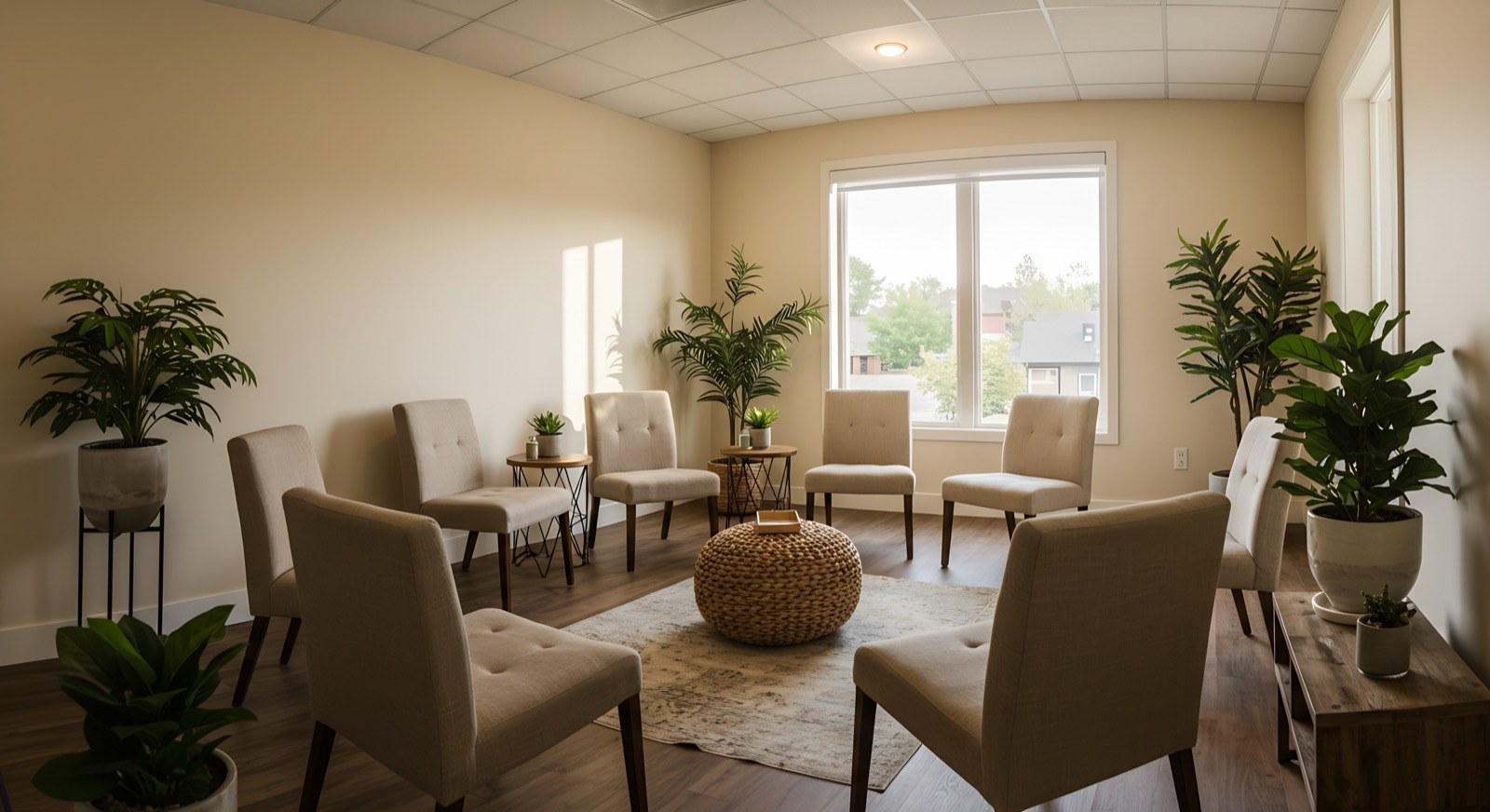
South Jersey Recovery Program is licensed by the New Jersey Department of Health as an Outpatient Substance Use Disorder Treatment Center, license #2001009. Our office is at 1044 NJ-73, Suite A, in Berlin, and you can see the space before you walk in. Clients drive in from Cherry Hill, Voorhees, Marlton, Sicklerville, and the rest of Camden County; the areas we serve page has the routes. The admissions page covers what happens between the first call and your first day.
Call (856) 788-6914 or contact us online. The consultation is confidential, and we can verify your insurance on the same call.
Sources
- American Society of Addiction Medicine. The ASAM Criteria: Treatment Criteria for Addictive, Substance-Related, and Co-Occurring Conditions, fourth edition, 2023. Level 1.5 (Outpatient), Level 2.1 (Intensive Outpatient), and Level 2.5 (High-Intensity Outpatient, licensed in New Jersey as partial care).
- New Jersey Administrative Code, N.J.A.C. 8:43K-6.12 (partial care services).
- New Jersey P.L.2017, c.28, benefits for treatment of substance use disorder (S3 1R). pub.njleg.gov/bills/2016/PL17/28_.HTM
- National Institute on Drug Abuse. Principles of Drug Addiction Treatment: A Research-Based Guide, third edition, revised January 2018. nida.nih.gov/sites/default/files/podat-3rdEd-508.pdf
- U.S. Food and Drug Administration. Approved medications for opioid use disorder and alcohol use disorder; disulfiram prescribing information via DailyMed, label updated October 7, 2025.
Is this the right level of care?
An admissions coordinator can walk you through the options in a few minutes. The call is confidential.
From the blog
Related reading

Addiction Treatment
Partial Hospitalization vs. Inpatient Rehab
PHP offers intensive daily treatment while you live at home. Compare partial hospitalization with inpatient rehab to find the right level of care.
Addiction Treatment
Benefits of Local Addiction Treatment in South Jersey, and When to Go Farther
When treatment close to home in South Jersey helps, when leaving is the better call, what research says about distance and follow-up, and how to vet a program.

Addiction Treatment
How to Find the Best Addiction Treatment Program
How to choose an addiction treatment program: match the level of care, verify the license and network status, and ask the questions brochures avoid.
Areas we serve
Coming from a nearby town?
We have one office, in Berlin. These town guides cover the drive and what to know first.
Reviews
What clients and families say
5.0 out of 5 on Google, from 10 reviews
Read our reviews on GoogleReviews are written on Google by individual clients and family members. Results vary, and no review is a guarantee of any particular outcome.
Insurance
We work with many major insurance plans
What your plan covers depends on your policy and on whether we are in network with it, and we check both before you start. These are some of the plans our clients use. A logo here does not mean we are in network with every product a carrier sells. Whether or not you see your plan, request a verification and we will confirm your benefits and your network status before you start.









Recovery is waiting for you
Talk with our admissions team. Calls are confidential, and we will check your insurance benefits and call you back with what we find.